
Submitted by admin on March 12th, 2026
In the financial markets, a global conflict usually comes as a shockwave, however, in the case of India, the shockwave is even more severe due to high interdependence of the country in the global market in terms of energy and in trade routes and geopolitical alliances. The existing conflict on West Asia has become a concern amongst policy makers, investors and enterprises in India. As world markets respond to uncertainty, the way the stock market reacts in India is being influenced by both economic reliance on imported oil and investor feeling, and currency and sector specificity.
India is among the greatest importers of crude oil in the world. The imports provide over 80 percent of the total crude demand in the country and a significant share of the imports is provided by West Asian countries. The oil prices tend to increase whenever a war erupts in the area either due to interference of supply or due to the fear of a blocked shipping route.
To the case of India, raising the cost of oil is directly translated to an enormous import bill. This strains the balance of trade in the country, and rupee is undermined. The cheaper rupee makes imports even more costly, which leads to creating a vicious circle that may reinforce inflation and decelerating economic growth. This leads to the investors becoming hesitant about the Indian equities.
Indian stock indices are generally volatile during geopolitical tension. The exposure to the emerging markets is also minimized by investors, particularly the foreign institutional investors (FIIs) and transferred to more secure investments such as U.S. government bonds or gold.
When these outflows of capital occur the benchmark indices in the country like NSE Nifty 50 and the BSE Sensex are likely to decline. The immediate response is normally more of fear and uncertainty than the actual economic harm. In case the war lasts long, market pressures could be higher because of the increase of oil prices on the markets and inflation issues.
Nevertheless, the stock market in India has been resilient to the previous crises in the world. The market can stabilize after the initial shock with the assistance of strong domestic consumption, government expenditure, and long-term economic growth.
The most significant variable that connects wars and the Indian economy is oil. In case of the drastic rise in the price of crude oil, a number of sectors are hit at the same time in India.
To begin with, there is the rise in transportation costs. Other sectors that are affected by the increased fuel costs include aviation, logistics and shipping sector, as the profit levels decrease. Airline companies, in particular, are especially sensitive to the cost of fuel that increases since one of the operating costs is occupied by the cost of fuel in aviation turbines.
Second, the increasing oil prices increase the cost of manufacturing and transportation in the economy. This impacts on industries like motorcycles, consumer products and chemicals. The companies might end up absorbing those costs, hence decreasing profits, or transfer costs to consumers, thus, enhancing inflation.
Third, the increase in the prices of fuel in India strains retail inflation. In case of inflation increasing too rapidly, the central bank can maintain the interest rates high or postpone reduction in interest rates and this will slow the economy and it will burden the stock prices.
The other important consideration in the event of international war is the flow of foreign exchange. Foreign institutional investors make large investments in the stock market of India.
When the world is experiencing geopolitical uncertainty, most investors all over the world tend to cash in to less risky assets or those in developed markets. This may result in the exit of foreign capital in the emerging markets such as India.
In case of the high outflows, the rupee can also depreciate against the U.S dollar. Having a weak currency may rise the price of imported goods and contribute to inflation. The volatility of currency also raises the level of caution among investors towards the Indian assets.
Yet, the promising economic growth opportunities in India tend to bring investors back when the situation on the international level comes to normal.
The Indian stock market reacts differently in various ratios to global conflicts.
When the prices of crude oil increase, it may be of benefit to the oil exploration and production companies as their income increases. Oil marketing companies are however subject to pressure when the government does not allow them to fully transfer the increased fuel costs to consumers.
They tend to be the largest losers in the times of an increase of oil prices as these sectors are the largest. The cost of fuel is a significant expenditure and increased prices will decrease profitability.
Increasing fuel and transportation prices will decrease the purchasing power of the consumers. This can reduce the demand of automobiles and some consumer goods.
Defence manufacturing is one of the industries that can be useful in case of conflicts in the world. During the times of geopolitical tension, governments tend to allocate more money to military expenditures. The other aspect of India that has been on the move to embrace is the reinforcement of its local defence production, which may provide some space to companies in this industry.
The IT industry in India might be indirectly hit. International firms might cut technology expenditures in case there is a decline in the worldwide economic growth because of war. Nevertheless, the long-term growth overall trend in the sector is usually maintained.
The government of India pays close attention to the international conflicts due to the effects they might have on the economy. In case of a sudden increase in oil prices, the policymakers can take some measures to check the inflation levels and to stabilize the economy.
Such options can be the offering of relief in terms of fuel taxes and changing policies on imports or the use of strategic petroleum reserves. The central bank can also interfere in the currency markets so as to minimize volatility.
These policy responses can be used to curb the geopolitical crisis effects on Indian economy and financial markets in the long-term.
The Indian stock market has gone through a number of geopolitical shockers in the previous past such as the Gulf war, the war in Iraq and other crises that have hit the world. The market responded in most scenarios with steep drops, but it is on recovering as the situation took a turn.
Consequences According to the history, long-term investors who had remained invested at the times of uncertainty always benefited when market recovered. This trend indicates the latent robustness of the Indian economic development that is led by internal demand, massive population, and the growing industries.
Though wars may cause some temporary instability, they hardly alter the overall trend of growth of a given economy such as India. The long-term potential of the country – through building infrastructure, going digital.
In the Indian perspective, the main impacts of wars in the other parts of the world like West Asia on the economy are in terms of oil prices, inflation, currency movements and foreign investment flows. These can both cause volatility in the stock market in the short term and strain some sectors.
Int Rates : 10.5% - 22%
Loan Amount: ₹ 1,00,000.00
Maximum Tenure - 7 Years
Lowest EMI : ₹ 1,686
Interest Rate 13.99% - 24.99%
Loan Amount: ₹ 1,00,000.00
Maximum Tenure – 5 Years
Lowest EMI : ₹ 2,326
Interest Rate 9% - 13%
Loan Amount: ₹ 1,00,000.00
Maximum Tenure – 20 Years
Lowest EMI : ₹ 1,014
Interest Rate 8.40% - 12%
Loan Amount : ₹ 1,00,000.00
Maximum Tenure – 35 Years
Lowest EMI – ₹ 739
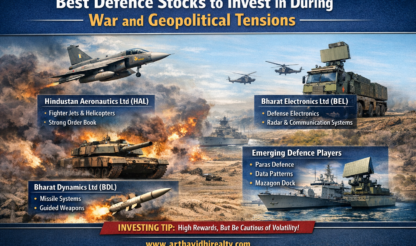
The presence of military conflict and geopolitical unrest has affected the financial markets, presenting both risks and opportunities. Historically, the defence sector has always benefited from military conflicts. As tensions around the world in....
Read More
War-time financial markets are fueled by fear, uncertainty and rapid capital changes. Investors usually position themselves along a continuum of low-risk and stable investments (e.g. cash/gold, etc.) to high-risk/varying return investments (e.g.....
Read More
Silver has been thought of as a valuable asset which was used as a precious metal and as an industrial commodity. In recent years, investors have been considering the use of silver as a means of diversification of their portfolios, to hedge agai....
Read More